 SPEAK TO US
 Hire Quote





 My Account




 Hire
Hire Depot
Depot My
My





For many landscaping and groundworks projects, a mini digger becomes the sensible next step once work moves beyond what can realistically be done by hand. Digging out levels, clearing soil or preparing foundations all take time, and on most domestic sites, there’s limited space to work with. In those situations, a compact machine that can do the heavy lifting without taking over the whole site often makes the difference.
We see this regularly at Smiths Hire. Customers often start out planning to manage with hand tools, then reach a point where progress slows. That’s usually when they start looking to hire a mini digger, not to overcomplicate the job, but to keep things moving and finish the work properly.
Who can hire a mini digger?
First things first, who can actually hire a mini digger? In practice, pretty much anyone can. We hire mini diggers to both trade customers and private individuals all the time. You don’t need to be in the trade, and there’s no requirement for a trade account, as long as the machine’s being used on private land and for the kind of work it’s meant for.
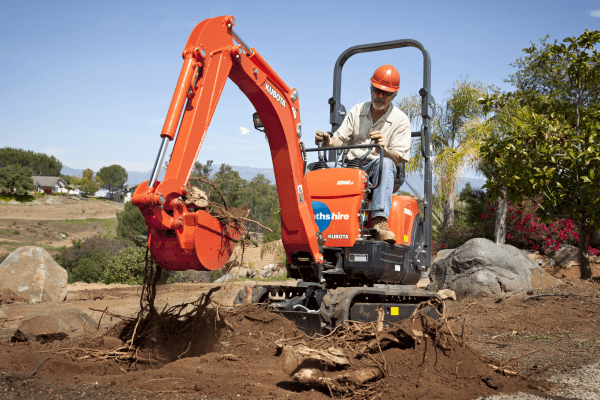
Because of that, mini digger hire is very common on domestic jobs. Garden landscaping, digging out drainage runs, prepping ground for extensions – it’s everyday stuff. The machines are compact enough to work around houses and gardens without causing disruption, but they’ve still got enough weight and power to handle tougher ground when needed.
Do you need a licence to use a mini digger?
This is another one we get asked a lot. In most cases, you don’t need a licence to operate a mini digger. As long as it’s being used on private land and not driven on public roads, it can be operated by anyone who knows what they’re doing.
For most domestic and landscaping jobs, that keeps things simple. Where people tend to come unstuck is when a machine needs to cross a public highway, even briefly. That’s a different situation and usually needs planning around transport rather than driving the machine itself. For work that stays on-site, it’s rarely an issue.
Where mini diggers are usually used?
A mini digger really comes into its own on sites where space is limited. That’s why they’re so common on domestic jobs and smaller developments. Gardens, backyards, side access routes, places where a full-sized excavator would be overkill or wouldn’t fit at all.
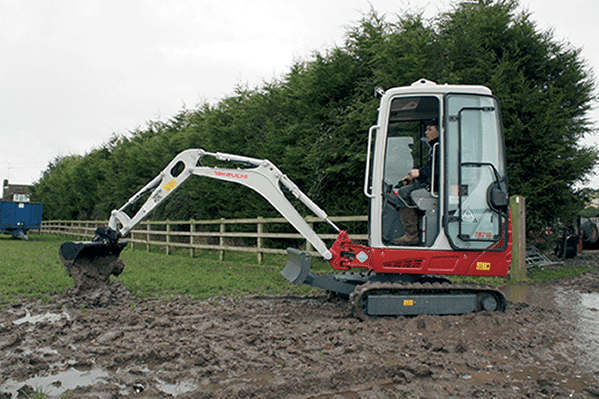
We see them used for digging trenches, reshaping gardens, clearing spoil, preparing footings and taking down small structures. With the right attachment fitted, a mini digger can also handle jobs like breaking up concrete, which often surprises people who assume they’re only for light digging.
A few things worth thinking about before you hire
Before you hire mini digger equipment, it’s worth having a proper look at the site. Access is usually the first thing to check, not just whether the machine fits through the gate, but whether there’s room to work once it’s in.
Ground conditions matter too. Soft ground, slopes or uneven surfaces can all affect how a mini digger behaves, especially in gardens that haven’t been worked on before. Tracked machines help spread the weight, which is one reason they’re commonly used on domestic sites.
Attachments are another thing people sometimes leave until the last minute. Buckets, breakers and specialist tools can make a big difference to how smoothly the job runs, and it’s usually easier to get that sorted before the machine turns up.
Choosing the right mini digger
When it comes to picking the right mini digger, it’s really about matching the size and strength of the machine to the job you’ve got lined up. At Smiths Hire, we’ve got machines that cover most bases from the very compact through to something with a bit more grunt, so whatever you’re digging, lifting or clearing, there’s usually a good fit.
Take the very small end of the fleet, for example. The 0.8t Kubota K008-3 micro/mini digger will get into spaces that a lot of bigger machines simply can’t access. We’ve seen them used in tight back gardens where access was only just wide enough. Then there’s the slightly larger 1.1t Kubota U10-5, which still has a narrow footprint but feels more comfortable under continuous use.
 For most domestic landscaping and groundwork jobs, machines in the 1.5t to 1.7t category are very popular. The Kubota 1.5t mini digger we’ve got on the fleet handles firm ground and slightly heavier digging easily, and the 1.7t Kubota U17-3A gives a bit more reach and digging depth without feeling like overkill.
We also keep some alternative options, like the 1.6t hybrid mini digger by Takeuchi, which lots of customers choose when they’re thinking about fuel efficiency without losing performance, and the 1.9t electric mini digger by JCB, which is ideal in tighter or enclosed spaces where fumes and noise matter more.
Hire a mini digger from Smiths Hire
We’ve been supplying equipment like this for a long time, and most mini digger hire follows the same pattern. Someone’s got a job to do, knows roughly what they need, and wants a machine that turns up ready to work.
If you’re unsure which mini digger is best for your site, it’s usually worth having a quick conversation before booking. A few details about access, ground conditions and the work itself can help avoid problems later on.
 To hire mini digger equipment or talk things through, you can just give us a call on 0333 323 2100 You can also take a look at our range of mini digger hire options here online or visit one of our 19 depots across the North, conveniently located in or near major cities such as Manchester, Liverpool, and Leeds.