 SPEAK TO US
 Hire Quote




 My Account




 Hire
Hire Depot
Depot My
My



When your worksite is open, flat and predictable, choosing powered access hire equipment is usually fairly straightforward – but as most professionals know, that isn’t often the case. Tight footprints, uneven ground, restricted entry points and busy working environments can quickly complicate decisions around access hire, especially when multiple trades are involved, and programmes are under pressure.
For contractors, site managers, FM managers and engineers, choosing the right access solution is about making sure equipment can be delivered, positioned and operated safely without disrupting workflow or compromising productivity. That’s where we come in. At Smiths Hire, we’ve been supporting construction professionals for more than 55 years, keeping your projects moving even when site conditions are less than simple. Let’s take a look at what you need to consider when choosing construction site access equipment for difficult spaces.
Understanding the challenges of your site
No two construction sites are ever quite the same, and challenges usually become clear as soon as work gets underway. Issues like restricted entry points, uneven or soft ground, overhead obstacles and narrow internal layouts can all have a big impact on what access equipment will actually work on site. Often, the biggest challenge isn’t reaching the work area itself, but getting the equipment into position safely and efficiently. That’s where careful planning around delivery, offloading space and on-site movement makes a real difference, helping to avoid delays further down the line. We always recommend reviewing site drawings, checking access widths, and thinking through turning space, lift positioning and ground conditions when choosing your equipment, so it arrives ready to work without unnecessary disruptions. On difficult sites, coordination between teams becomes just as important, helping to prevent congestion and keeping equipment moving efficiently.
Choosing equipment based on ground conditions
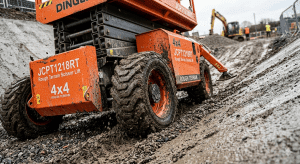
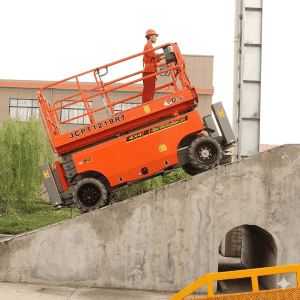
Before choosing your equipment, it’s worth taking a step back and considering the ground conditions. On outdoor sites, soft or uneven ground can be tricky to navigate and can lead to delays, restricted movement and additional safety considerations, often resulting in downtime while the setup is reassessed or changed. This is where all-terrain cherry picker hire is particularly useful, helping operatives work safely while maintaining mobility and stability. Something like the Niftylift HR12NDE Cherry Picker is designed with challenging construction sites in mind, featuring deep tread tyres that are perfect for navigating soft terrain. Similarly, the Dingli JCPT1218RT scissor lift is ideal for driving off-road and handling inclines of up to 40%, with automatic hydraulic levelling outriggers for additional stability.
Understanding space constraints
Space is often one of the most crucial factors to assess when choosing access equipment, and it’s especially important on a construction site where layouts are tight or multiple trades are working in close proximity. Every metre matters, so it’s essential to choose equipment that can work around obstructions rather than adding to them. That might mean choosing a narrow cherry picker like the Genie Z-33/18. Combining a compact design with impressive manoeuvrability, this machine can fit through standard doorways and offers a tight turning radius that’s ideal for tight spaces.
On the other hand, if you’re looking for a machine that can safely reach over obstacles, the JLG 1850SJ Diesel Telescopic Boom offers a maximum working height of 58.56m and a maximum outreach of 24.38m. Compact and efficient, its telescopic jib gives you 2.9 million cubic feet of work area, making it easier to reach over obstacles and get into those harder-to-access spots without having to keep moving the machine.
On challenging or fast-changing construction sites, it’s also worth considering how easily equipment can be moved or repositioned once work is underway. Some machines are better suited to frequent adjustments around your site, enabling your teams to shift position quickly as different areas become available. This includes the JLG Toucan 12E Plus, a self-propelled mast boom platform that’s quick to set up and easy to move across your site. Other options, like trailer-mounted access equipment, may require towing or additional setup time between moves, which can slow progress if the site layout is constantly changing.
Working safely in difficult environments
Working safely at height is always a top priority on any construction site, especially where conditions are more complex or less predictable. The more complicated the site layout, the harder it becomes to manage movement, positioning and visibility around access equipment, which is why following the correct procedures is essential.
All operators should be properly trained, equipment should be checked before use, and the site itself should be assessed to ensure conditions are suitable for the chosen machine. At Smiths Hire, we support site safety by providing a range of IPAF training courses, helping operators build confidence and competence when using powered access equipment.
Clear planning on-site also plays a key role in reducing risk. Barriers, exclusion zones and good communication between ground teams and operators all help to ensure equipment can be used safely. Where visibility is limited, additional support from banksmen or spotters can help to guide positioning and movement.
Those are some of the key points to consider when choosing powered access hire equipment for your site! However complex your project may be, having the right support in place can make all the difference, keeping work moving safely and efficiently day after day.
At Smiths Hire, we’re proud to provide leading brands at competitive prices, all expertly maintained for first-class reliability. With guaranteed next-day delivery for all powered access machines, you can keep even the most difficult project on track and successfully navigate all kinds of construction sites. Unsure what kind of machine will work best for your challenging space? To learn more about our powered access hire solutions or IPAF training courses, give us a call on 0333 323 2100 or pay a visit to your nearest Hire It Centre today